














Activity: Straw-Rocket Aeronautics
(Lesson courtesy of NASA/Jet Propulsion Laboratory’s education office and a favorite of education outreach specialist Jojo Aguilar.)
Summary
In this fun activity, students of all ages learn about rocket stability by constructing and flying small “indoor” paper rockets, then analyzing flight data and interpreting the results.
Grade level: K-12
Time: Less than 30 minutes, start to finish
Standards
National Science Education Standards
- A: Scientific inquiry
- B: Motions and forces
- E: Technological design
NCTM Mathematics
- Measurement
- Patterns and functions
Common Cores State Mathematics Standards
Measure, represent, and interpret data (grades 1 – 5)
ITEA Technology Education:
NT.K-12.3 Technology productivity tools
Learning Objectives
After doing this activity, students should be able to:
- Conduct an experiment
- Collect, analyze, and interpret data
- Draw conclusions from results
- Describe how design affects performance
Materials
Per student or team:
- Rocket template & data analysis worksheet (.pdf)
- Pencil
- Scissors
- Tape
- Drinking straw
Procedure
Who doesn’t love rockets? Or blowing through a soda straw? In this experiment, students get a hands-on feel for rocket stability and aerodynamics by constructing and flying small paper rockets propelled by air blown through a straw. The goal is for students to conduct an experiment, analyze the data, and interpret the results. Also to have fun!
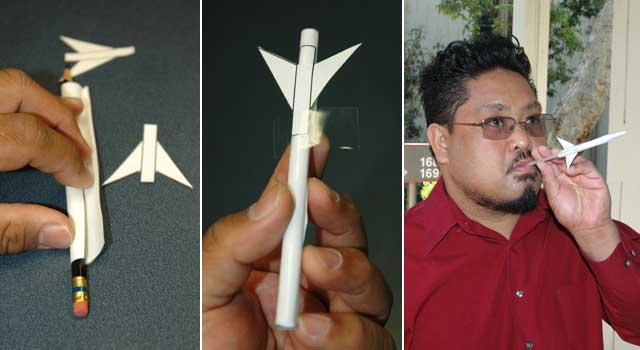
NASA/JPL straw rockets
JPL’s Jojo Aguilar shows how to make the rocket: Cut out the template, wrap the long rectangular section around a pencil, tape the fins, insert a straw and blow! Image credit: NASA/JPL
1. Download and print the soda-straw rocket template, at least one per student or group, from: http://www.jpl.nasa.gov/education/images/pdf/sodastrawrocket.pdf
2. Carefully cut out the pieces and assemble the rockets according to the template’s instructions. Once completed, you will have a nice little rocket that stands just over 5 inches tall.
3, Insert a soda straw into the rocket and blow into the straw.
4. Watch your rocket as it flies. How far does it go? Does it fly straight or does it tumble in midair? Record the rocket’s length and how far it travels using the template’s data log.
5.Launch your rocket a few more times to see if it flies the same way. If you would like to record your rocket flight distances, be sure to launch it from the same place each time, and measure to the landing spot with a tape measure.
6. Next, make rockets of different lengths to see how that affects the results. (Vary the length by cutting the tube that forms the rocket.)
Extensions
- Math connection: Have students observe how their rockets landed in a scatter plot, much like a graph.
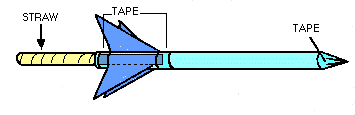
- Start by making simpler rockets without fins. Cut one piece of paper into quarters, wrap one of the paper rectangles around a pencil to form a cylinder, with the long edge of the paper along the length of the pencil, and tape the cylinder closed so it does not unravel (but do not tape it to the pencil). Pinch one end of the cylinder shut and seal it with tape. (This is the “front” end of the rocket.)
- When students are finished recording data, see if they can use their findings to improve on their designs (or design entirely new rockets) and fly further on a second trial flight, or reach objects, such as a classroom globe.
- Students should work in groups of four to six and build rockets of different sizes. They can share data and discuss how rocket length affects distance.
- Let students personalize their rockets by coloring or drawing on them.
Resources
NASA’s Flight Testing Newton’s Laws uses video clips of test pilots to explain Newton’s three laws and spark high school students’ interest the physical sciences and mathematics. The 10-lesson course includes a “flight instructor’s manual” to help guide teachers and students through thrust, drag, and other concepts.
NASA’s Aerospace Activities and Lessons include a wide array of hands-on activities developed by teachers and NASA educators.
Ultimate Straw Rocket! YouTube video [0:51] on how to make a super-high-flying rocket.
Build a Paper Rocket Scientific American’s version of this activity includes short, accessible explanation of aerodynamics, force, and drag.
Filed under: Class Activities, Grades 6-8, Grades 9-12, Grades K-5
Tags: Aerodynamics, Aeronautics, Aerospace, Aerospace Engineering, aerospace lessons, inquiry, Mathematics, NASA, rocket, rocket stability, straw rocket